
+ What is Gestalt therapy?
In Gestalt therapy, it is not only about talking about one’s own issues, but also about becoming more consciously able to experience them — in thought, feeling and in the body.
This allows the current distressing issue to be experienced in a different way and creates awareness of one’s own patterns and entanglements, as well as the needs underlying them. We meet the inner parts and feelings involved with appreciation, while the body can serve as an important source of information and as a medium through which change can be explored and perceived.
In my understanding, Gestalt therapy is, alongside various interventions, above all an attitude that combines openness, love and curiosity, leaves the client in their own responsibility, and supports natural development and unfolding.
+ Who is Gestalt therapy for?
Often people come to me who learned early on to just function, to conform, or to “survive” rather than to live— and who now feel that they want to reconnect with their own lives again, with their bodies, and/or their emotions.
It is often people who learned early in life to take on a lot of responsibility. They now realize that they can manage their lives, but they no longer feel truly connected to themselves.
Another core theme is having already gained a lot of insight into oneself and being able to analyse and reflect on oneself, while somehow this knowledge has not yet become rooted in the body. The body and nervous system may still react in ways that feel difficult to understand or regulate. I can support you in reconnecting with your body and in creating more communication between mind, body and soul.
+ How does a therapy session look like?
At the beginning, we explore together what issue is most present and what we will continue working with. In doing so, we rely on the Gestalt principle that what is currently relevant for one’s own development — and for which there may be just enough capacity at that moment — will emerge and reveal itself.
The process can then take very different forms, vary in its length and form, and differ from session to session as well as from person to person.
Then basically a process continues to unfold itself from moment to moment. This, too, can look very different to varying degrees. Sometimes it's more verbal, sometimes more imaginative or physical.
+ Are all my problems solved at the end of therapy?
Well, let’s put it this way: some issues may be resolved and some chapters may come to a close. But it doesn’t always have to happen that way. Some things need time and the experiences of everyday life in order to become integrated, and some things may not yet be ready to be fully closed. All of these possibilities are normal and completely okay.
For most clients, therapy helps them develop greater awareness of themselves, their inner processes and their bodies. Often, this also enables them to relate to themselves differently and find new ways of self-regulation.
And through this awareness for oneself, more room for deliberate action, freedom of choice and independence can grow.
+ How long is one session and how often do they take place?
A therapy session usually lasts 50 minutes. If needed, it can also be reduced to 25 minutes or extended to 60 minutes.
Sessions often take place once a week. In order to enter into a flowy therapeutic process, it is usually helpful to come once a week. However, it may also be more suitable to meet every two weeks or to have longer intervals between sessions. This is your decision.
+ How long does therapy take?
This also varies, as each person comes with a different concern and brings different previous experiences to the table.
I usually suggest starting with five initial sessions to get to know each other, during which you can see whether our work together is helpful for you.
After that, the further process develops individually, and ultimately you decide when you would like to end therapy. Usually, this means working together for several months to some years.
+ What are the costs?
A regular session (50 minutes) costs €100 for self-paying clients
and €130 for clients with private health insurance or supplementary insurance, if their insurance covers this form of therapy.
In some cases, it may also be possible for clients with statutory health insurance to have the sessions reimbursed in full or in part through the reimbursement procedure.
Please contact your health insurance provider for more information about the reimbursement procedure.
It is important to me to make psychotherapy as accessible as possible. If the costs as a self-paying client are a barrier for you, please do not hesitate to speak to me about this.
+ What is the cancellation policy?
Appointments cancelled less than 48 hours in advance will be charged at the regular agreed session fee.
Where are the sessions held?
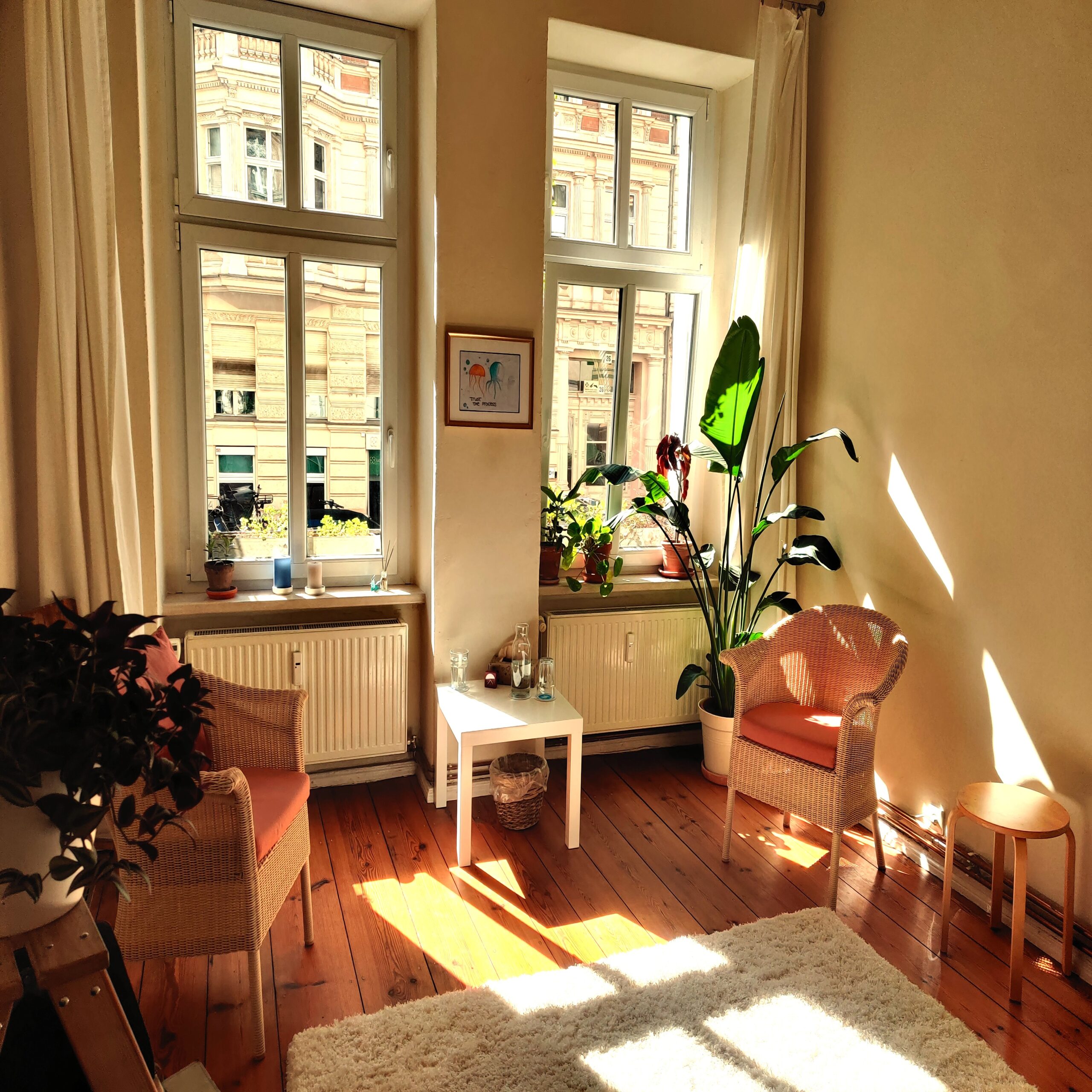
On Mondays, Wednesdays and Thursdays, sessions take place here:
Private Practice for Psychotherapy
Solmsstraße 30
10961 Berlin-Kreuzberg
The entrance is in the passageway to the courtyard, on the left-hand side.
(There are a few steps, so the practice is not wheelchair accessible.)
On Tuesdays, sessions take place in Wedding. The address is:
Bewegungsraum Wedding
Antwerpener Straße 3
13353 Berlin
The entrance is on the ground floor on the right-hand side, with wheelchair-accessible entry.
Online:
The first sessions usually take place in person. After that, online sessions are possible under special circumstances.